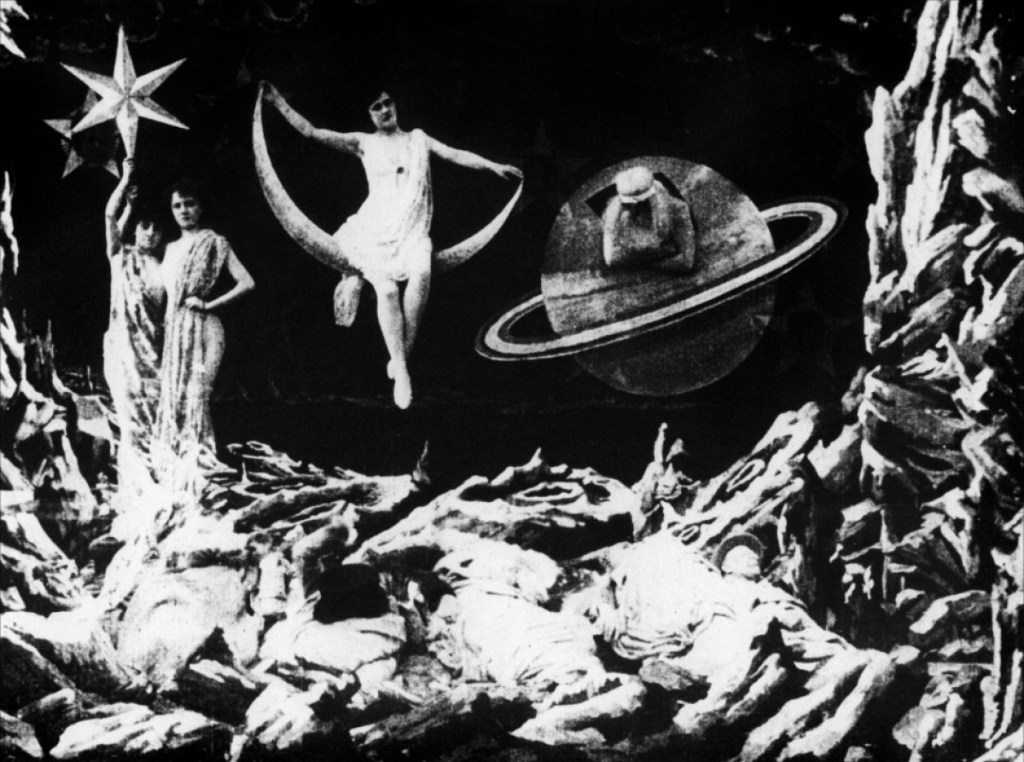
The screenwriting craft changed a lot over time and became more than a technical document to pave the way for filmmakers to make their films. In one of the earliest scripts (Le Voyage dans la Lune, 1902) written by Georges Méliès, we notice a very permeative attempt to build a sequence of continuous actions that lead to what became modern days movies. What stands out in this film is that it marks the beginning of the ‘artistic’ craft of the making. Story wise, it contains advanced thoughts and contemplations about the relationship between humans and the world around them in comparison to most of the previous films captured prior to (Le Voyage). It follows a group of astronomers who travel to the Moon in a cannon-propelled capsule, explore the Moon’s surface, escape from an underground group of Selenites (lunar inhabitants), and return to Earth with a captive Selenite. The previous films focused on capturing real people from the environment around the filmmakers with no story to very simple story making them closer to documentaries than to fiction. Due to the multiple scenes of Le Voyage that required specific set ups, the script came as a technical document to ‘follow’ the act of action and to make sure that all the story chapters were covered. Although that the so-called script is very short and generic, it highlighted the need to have a written document to tell a story with depth and details for the filmmaker himself to witness the flow of the supposed scenes, and for the collaborators to be on the same page with the maker. It is indeed an unforgettable moment in the history of screenwriting craft when having a script became an urgent requirement to make a solid, well-plotted film.
Currently, the screenwriters provide more than a sequence of events. They contribute to the creation of the film by creating characters with both physical and psychological traits. They think about the history of these characters and think about their inner battles and how they reflect on their actions. Moreover, the scene in the modern scripts is more than a description of a concept. It is a 3 dimensional unit of place, time and actions. The craft also evolved to allow writers to suggest techniques to cut the scenes while writing (ex: montage, fades, intercuts, flashbacks..etc). Furthermore, modern scripts contain dialogues that push the action further, reveal parts of the characters, and make the movie relatable for the viewers
In his book, A History of the Screenplay, Steven price talks about the evolution of the screenwriting craft and how it changed over time. In fact, the screenwriting practices got creative, bold, and updated with the evolution of the filmmaking. He also mentioned examples in which the script was tolerant enough to handle new ways of carrying a cinematic story such as improvisation for example, which is describing the scene setting, circumstances, characters’ backgrounds to the actors, and let them express the dialogue their way, which is completely revolutionary and highly liberated from the dictation of a classical dialogue.
I believe there is always a gray area between the script on paper and the film on screen. No matter how specific the script is about the dramatic outcome expected from it, there is still a gap between the wild imagination of the writer and the reality of the film production on ground. This does not mean the script is a less important phase in the film’s life, it only means that when it’s coming to life as a film, it evolves to other shapes and dimensions to serve the motion picture.I think having this sense of understanding about the ‘possible changes’ a script can endure is healthy for the filmmaking craft, especially when the writer’s are aware of the reasons behind changes. In cases of improvisation films, it is important to understand that such type of films takes its ‘real’ flavor from the ‘rawness’ of its dialogues, from the ‘spontaneous’ lines that are generated instantly .When screenwriters are thinking freely about their upcoming script, I think being bold about how you see it delivered on the screen, and working with people who will preserve your idea should be a key. However, screenwriters who are working for specific commercial entities with specific vision and business goals are expected to know what kind of production they are catering? What are the rules/aspirations of this specific production? what are they trying to achieve? and what’s the most creative script input they can provide?
Finally, Screenwriters in general should have a sense of flexibility to be part of the future of the film-making. As everything in the industry is changing rapidly, our best chances to take part of this change is to be the driving force behind it. To be open-minded about new formats and treatments to our ideas, to discuss the possibilities and the opportunities of the script, away from what we see inside our own heads.
 AlRaweya الراوية